Located on top of Mingfeng (Singing Phoenix) Hill is the home of the Taoist Taihe Palace (Hall of Supreme Harmony), which is the largest copper temple in China. It is also known as the Tongwa Temple (Bronze Tile Temple) and by its popular name, the Golden Temple.
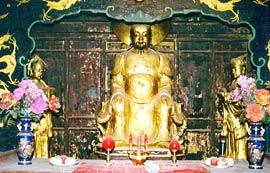
The history of the Golden Temple starts during the Ming Dynasty and the reign of the Emperor Wanli in 1602. At that time the governor of Yunnan Province was a devout Taoist who built this temple to honor the Taoist hero-god Zishi. According to legend, Zishi had a golden palace in the northernmost extremity of the universe. But the Golden Temple didn't stay in its original place for very long. Just 35 years later, in 1637, the entire original temple was moved to Jizu (Chicken Foot) Mountain in western Yunnan. Three decades later in 1671 during the Qing Dynasty, Wu Sangui, the governor of Yunnan Province, built an exact duplicate of the original temple. This temple was undisturbed for almost two hundred years until the Muslim rebellion of 1857, during which the Golden Temple suffered some damages. Emperor Guangxu ordered its complete repair and in 1890, using 250 tons (246 gross ton) of solid bronze, the entire temple was again rebuilt. Except for the staircases and balustrades, which are made of marble, the walls, columns, rafters, roof tiles, altars, Buddha statues, wall decorations and the banner near the gate tower are all made of copper. The burnished copper gleamed like gold and that is why people named it the Golden Temple. Since its last renovation, this beloved copper temple on the top of Mingfeng Hill has been well cared and has become the most famous Taoist shrine in Yunnan Province.
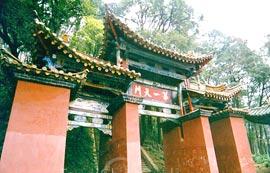
As with most Taoist temples, you approach it by climbing up a mountainside on winding stone steps and pass through a series of "Heavenly Gates". The three Heavenly Gates of the Golden Temple are highly decorated with painted archivolts and carved beams and rafters.
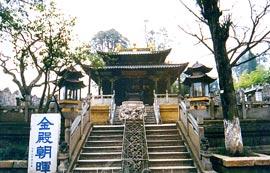
The beautiful walk up the stairs to the temple helps you to leave your mundane cares behind you. You may well find that the closer you get to the Golden Temple, the more peaceful and lighthearted you feel as the extreme beauty of Mingfeng can create a sense of inner harmony to its visitors.
At the end of the path, there is a miniature, medieval city wall standing on a platform. There you will also find the Lingxing Gate through which you could enter the Golden Temple. Among the interesting artifacts and artistry of the Golden Temple is a double-edged sword with the Big Dipper engraved on it. Legend has it that this sword, which weighs more than 20 kilograms (44 pounds), is the magic sword of Zhen Wu, a Taoist deity, who guards Mingfeng Hill. Near the temple is a 600-year-old camellia tree that signals the approach of spring every February by giving hundreds of exquisite blossoms.
Behind the Golden Temple, there is a three-story-high Bell Tower that was
built in 1984 to house a large, 580-year-old copper bell which is three point
five meters (16.4 feet) high and weighs an incredible 14 tons (13.7 gross tons).
The hillside around the Golden Temple abounds with pine trees, evergreens,
hardy cypresses, and a multitude of plants. As far back as the Qing Dynasty, the
natural beauty of Mingfeng Hill has caused it to be acclaimed as the Fairyland
of Mingfeng. The Golden Temple is only 11 kilometers (7 miles) from Kunming and
is easily accessible by public transportations.