Karez Well is a kind of underground water works invented and built by laboring people of various ethnic groups in our country to adapt to the natural environment in dry region. In Xinjiang, Karez Wells are mainly in Hami, Turpan and Mori, but they are most in Turpan Basin, where there are altogether 1100-odd Karez wells and have the total length of over 5000 km. Some people hold the view that Karez Wells of Xinjiang, the Great Wall and Canal constitute three Ancient Chinese Works. Why Karez Wells were built in great number in Turpan Basin can be attributed to the local natural geographical conditions. To the north of Turpan Basin is Bogda Mountain and to its west Kalawucheng Mountain. In summer, large amounts of snowbroth and rainwater flow into Turpan Basin and infiltrate into the ground, and constitute underground current, thus making an adequate water source under ground for Karez Wells. Earth in Turpan Basin is solid and good for building well and underground channel. In Turpan it is very dry and hot in summer, and land here has a high evaporation rate. In wind season, the strong wind here can blow sands into every corner here. After wind, a lot of farmland and water channels are buried by sands. But Karez Wells can supply waters through underground channels and is independent of the effect of season and wind and sand.
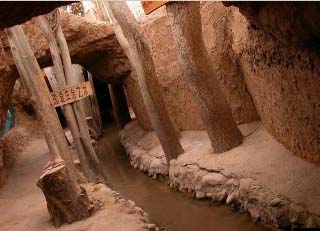
In addition, Karez Wells have a very low evaporation rate and a stable supply of water, and can irrigate farmland all the year round. The word “Karez” means well. Karez Well is composed of four parts: vertical hole, underground channel, aboveground channel and water storage dam. It is built this way: first, to find water source in a place where there is underground water current, second, dig out vertical wells with certain distance in between, then, to build underground channel connecting these wells and thus water will flow through the underground channel. The outlet of underground channel is connected to the aboveground channel and thus underground water can flow out and irrigate farmland through the aboveground channel.