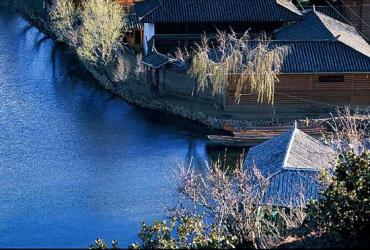
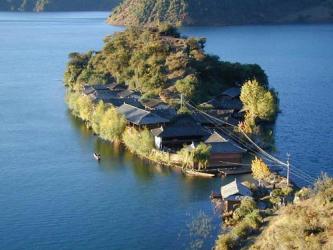
On the border of Yi Autonomous County in Ninglang in Yunnan Province and Yanyuan County in Sichuan Province, there is a plateau lake called Lugu Lake. Formed by the downthrows of a geological fault, Lugu Lake is the highest and the second deepest lake in Yunnan. It is known around the world not only for its beautiful natural scenery, but also because it is home to a unique matriarchate well-preserved by the indigenous Mosuo people, who are a branch of the Naxi (also spelt Nakhi and Nahi) ethnic minority group.
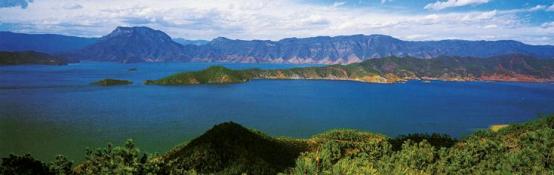
Lugu Lake is 300 kilometers (186 miles) away from Lijiang Old Town and 76 kilometers (47 miles) away from Ninglang County. With an altitude of 2,685 meters (8,809 feet) and an area of 52 square kilometers (12,480 acres), the average depth of the lake is 40 meters (131 feet) and the deepest point is 93.5 meters (307 feet). Embraced by the mountains, Lugu Lake had been isolated from the world until the 1970s. It is a fairyland which has never been exploited and polluted.
Lugu Lake is long and narrow, like a hoof filled with limpid water. Five small forested islands are interspersed across the surface, three of which are in Yunnan precinct. The smallest island is called Lige Island, and there are only eight Mosuo families living on it. Another island, called Chieftain Island, was named because Ayunshan, the chieftain of Yongning Village, had built a villa and lived here until his death in the Guangxu period of the Qing Dynasty. Simultaneously, Joseph Rock, an Austrian writer who was his friend, wrote part of the Ancient Nakhi Kingdom of South-west China (Harvard University Press, 1947) on this island. Liwubi Island, which lies three kilometers (one point nine miles) away from Chieftain Island, is actually a small peninsula extended into the lake by the Holy Gemu Mountain. The mountain is also called Lion Mountain, for it looks like a lion drinking water beside the lake. Mosuo people believe that a beautiful and kind goddess named Gemu lives on the mountain and blesses the residents at all times. A great sacrificial rite is held to worship the goddess on July 25th of each lunar year at the foot of Gemu Mountain.
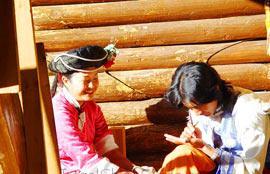
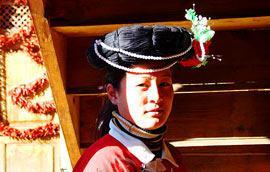
As one of the remaining matriarchal societies - which can be counted on one's fingers - Mosuo people and their customs are living fossils in a sense. In every family, according to the traditions of the matriarchate, women have the most important roles and they take on all the responsibilities of the families and the village. Children take the mothers' family names and live with their mothers. The relationship between the Mosuo lovers is called "Axia" instead of marriage in the common society. When the youth have gone through a Maturity Ceremony at the age of 13, they are permitted to choose their own Axia. Official procedures or documents are not needed here and the retaining time of this Axia relationship is based on the lovers' wishes.
Countless cultural sites and types of natural scenery make Lugu Lake an ideal tourist attraction: characteristic Mosuo villages, the Chieftain's Palace, the Zhamei Lamaism Temple, Yongning Hot Springs, the underground maze, Lucky Cave - and the most enjoyable things on the lake, which are the pretty and tender Mosuo girls, the ancient style canoes and the fair - sounding fishing songs. How can we resist a wondrous destination like Lugu Lake?