The Summer Palace -- the royal garden, is located ten kilometers to the northwest of Beijing and used to be a summer residence of Qing Dynasty emperors and is now a public park. It is an imperial garden famous for its architectural grandeur and gorgeous natural scenery.
Construction of the SummerPalace started in 1750. The northern part of the SummerPalace is the 60-meter-tall Longevity Hill. Its southern part is a wide expanse of water called Kunming Lake. The whole garden covers 290 hectares, with the lake taking up four-fifths of its total area.
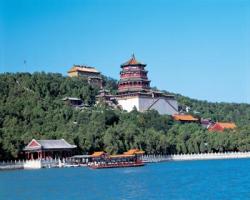
A cluster of grand buildings adorn the middle section of the Longevity Hill. On the slope from the lakeside to the hilltop stand a decorated archway called Jade-Like Firmament in Bright Colors, Cloud-Dispelling Hall, Hall of Virtuous Brilliance, Pavilion of Buddhist Incense and Temple of the Sea of Wisdom. Standing on the top of the hill, visitors command a spectacular view of buildings of different shapes and sizes below. Their golden roofs glittering under the sun; the placid, huge Kunming Lake dotted with rowing boats. A 17-arch bridge that connects an island with the lake's southern bank. The long, winding west bank of the lake is joined by six bridges and the distant West Hills.
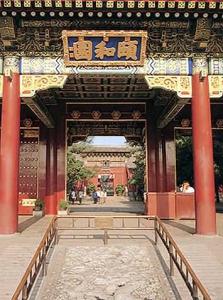
Along the northern bank of Kunming Lake runs the Long Corridor with a total length of 728 meters and 273 sections. It is like a necklace for Longevity Hill. Strolling in the corridor, a visitor sees an endless lineup of corridor stands stretching into the distance or curving away elegantly at soft angles as well as KunmingLake sparkling under the sun. The crossbeams of the Long Corridor are decorated with more than 8,000 color paintings with Chinese landscape and historical stories as their themes.
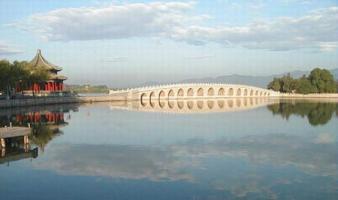
The 17-arch bridge on the southern bank of Kunming Lake is more than 150 meters long. Carved stone lions, of different sizes and postures, sit on top of the bridge's stone columns. An octagonal pavilion stands at one end of the bridge and near the pavilion lies a bronze ox with its head raised toward the lake. On the back of the ox is engraved a line from Emperor Qianlong stating that the ox is used to control flooding of the lake.
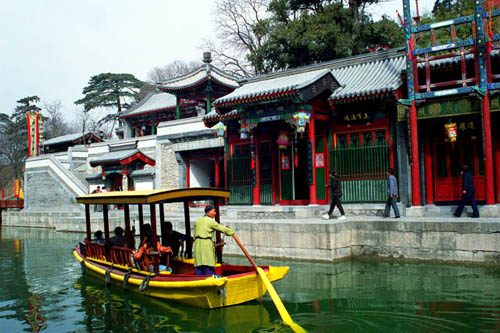
A Ming-style street winds along a stretch of water on the back side of Longevity Hill.
The Suzhou Street, 300 meters long, is lined with more than 60 shops and decorated with archways and gateways. The shops with different shapes and sizes, are built with bluish gray tiles and bricks. The market place lends a folksy flavor to the imperial garden.
Detailed introduction to the Summer Palace, the second largest imperial garden in China.
Equally famous as the Forbidden City, the Summer Palace is called "Yiheyuan" (Garden of Nurtured Harmony) in Chinese. It is up to now the best preserved and the largest imperial gardens in China. You may regret it if you come to Beijing and miss visiting these gardens.
Transportation: If you take a taxi to the Summer Place from Beijing city centre, it generally costs 80RMB(about 10 USD). The round way will cost about 160RMB(about 20 USD).
Entrance Fee: 40RMB(about 5 USD) per person